
Messina is a charming port city on the north-eastern coast of Sicily that is almost within touching distance of the Italian mainland across the Ionian Sea. Our one day in Messina was our first experience of Sicily. We loved Messina’s beautiful architecture, its open squares and greenery as well as the city’s warm, welcoming atmosphere.
Our one day in Messina was full of surprising discoveries. Messina certainly has deceptively steep hills and many steps! However, exploring the city on foot was worthwhile to discover Messina’s majestic landmarks in the skyline above the sea, enjoy the views and soak up the relaxed ambience.
One day in Messina was enough to gain a flavour of the city and a desire to return to Sicily and discover more. In this article, we share with you our walking itinerary that describes our authentic experience of what we discovered in one day in Messina on foot.
One Day in Messina Itinerary
Our one day in Messina itinerary includes the walking time between each destination on the itinerary and tips to help you make the most of your visit.
It also details some of the many free things to do in Messina. At Off the Tourist Treadmill, we love free things to do and see! In fact, our tagline is pay less, travel and experience more!
1. Messina Harbour – Cruise Ship Terminal
Our one day in Messina started at the cruise ship terminal on the Via Vittorio Emanuele II as Messina happened to be the third destination on our MSC World Europa cruise.
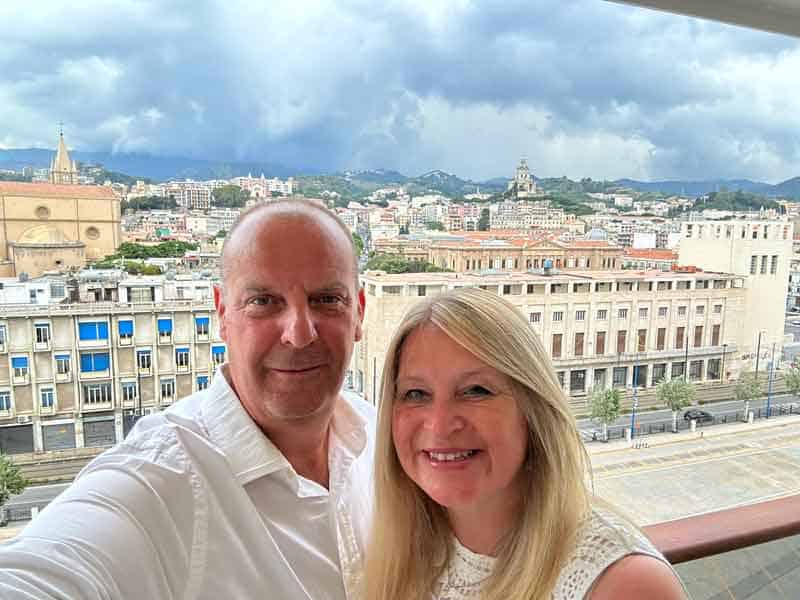
From the MSC World Europa, we could see a beautiful pink church and domed building above Messina, so we set out to find these landmarks before it got too hot and too crowded with guided tour groups and other travellers.
2. Fontana Falconieri (Falconieri Fountain)
After a 12-minute uphill walk from the cruise ship terminal, we found ourselves in a quiet square called the Piazza Basicò.
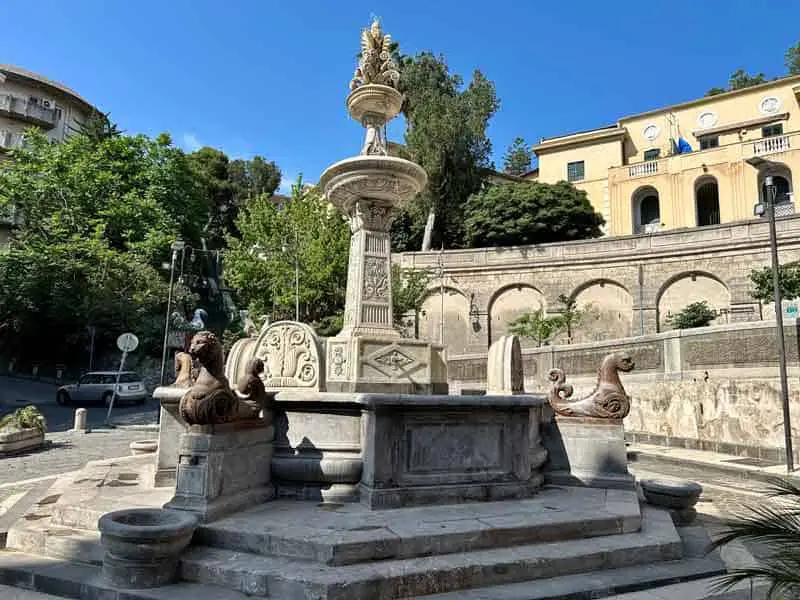
In the middle of this square was an intriguing fountain with sculptures of four sea monsters with the heads of a man, a lion, a griffin, and a dolphin. The Falconieri Fountain dates to 1842 and was designed by Carlo Falconieri.
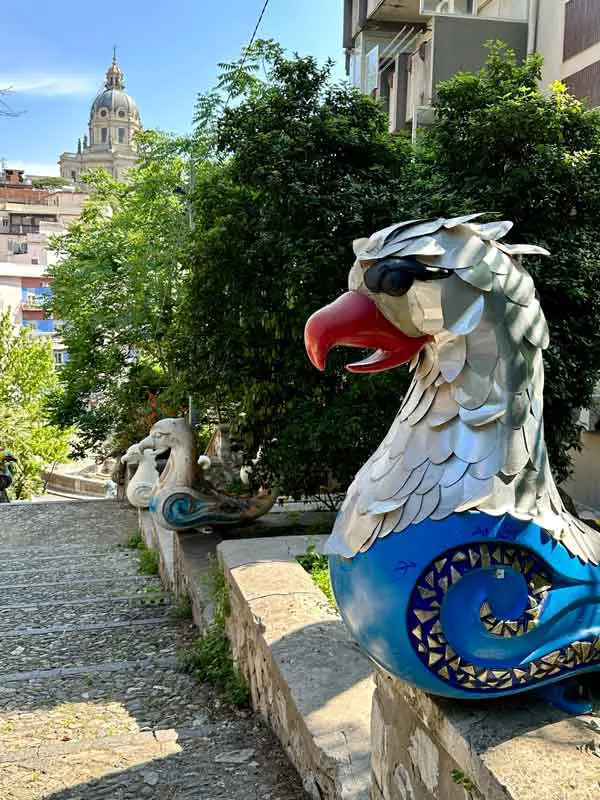
TIP: Don’t miss the curious staircase to the left of the fountain (the Scalinata d’arte) that is lined with large and colourful contemporary sculptures.
3. Scalinata d’arte – Rampa della Colomba (Art Staircase aka Rampa della Colomba)
The Scalinata d’arte staircase is also known as the Rampa della Colomba. It features nine different sculptures of mythological sea monsters (Sirenidi) inspired by the Falconieri Fountain.
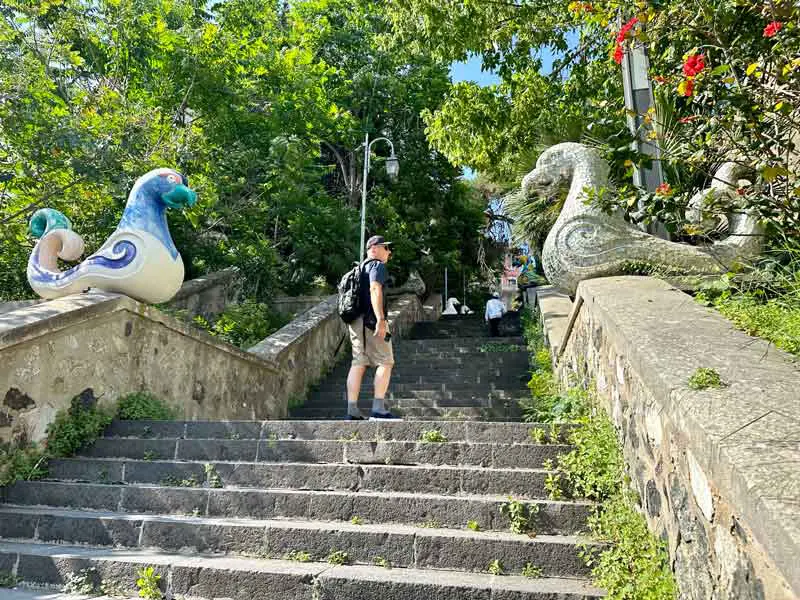
The resin glass sculptures are free to visit and were created by Carmelo Pugliatti and Enzo Togo and decorated by different artists from Messina: Paolo Bossa, Simone Caliò, Antonello Bonanno Conti (artist of two pieces), Filippo De Mariano, Concetta De Pasquale, Carmelo Pugliatti and Enzo Togo.
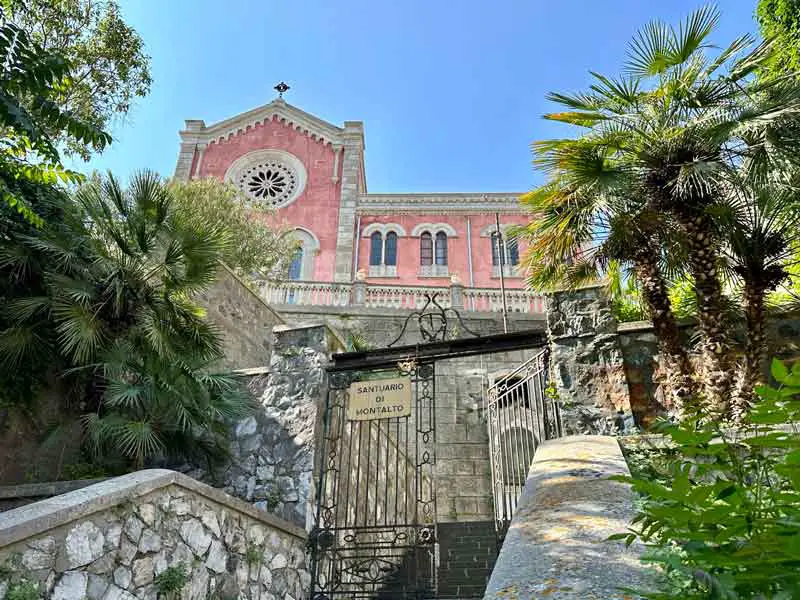
Naturally, we were intrigued about the sculptures and where the staircase would lead. After a 5-minute climb up the steps, we found ourselves at the gates of the Sanctuary of Montalto (the Santuario della Madonna di Montalto).
TIP: Following the Rampa della Colomba is the shortest route to visit the Sanctuary of Montalto. However, if you want to avoid the steps, there is a slightly longer, more accessible route from the Piazza Basicò via the Via Dina e Clarenza.
4. Santuario della Madonna di Montalto (Sanctuary of Montalto)
The Sanctuary of Montalto is a pretty pink church in the upper part of Messina. The church was rebuilt in 1928 on the site of a 13th century church that was destroyed in an earthquake in the early 1900s.
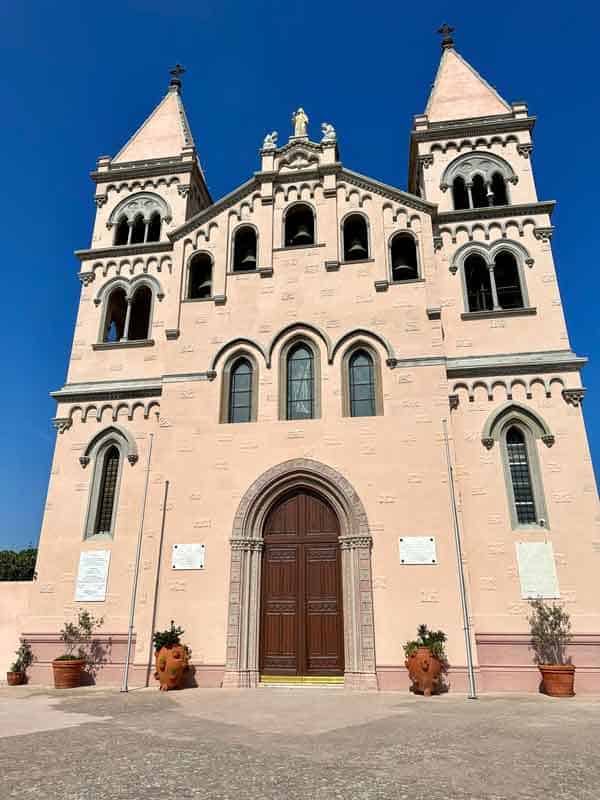
Although the church is a very attractive place to visit, the trek up to the Sanctuary of Montalto is definitely worth it for the view alone.
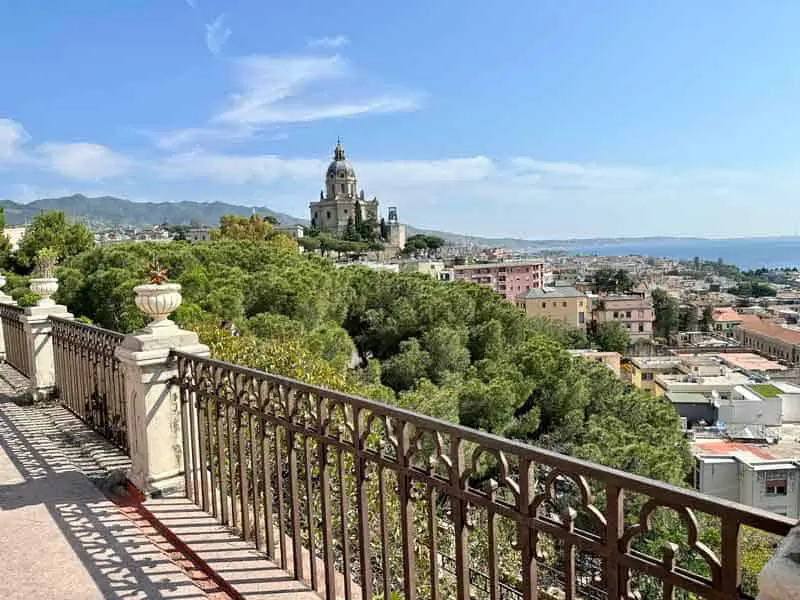
In front of the church there is a wide platform that gives one of the most beautiful viewpoints over the rooftops of Messina, its harbour, and the Strait of Messina all the way to the Italian mainland. It’s also one of the best places to take great photos of the Tempio Votivo di Cristo Re which is perched on the opposite hill.
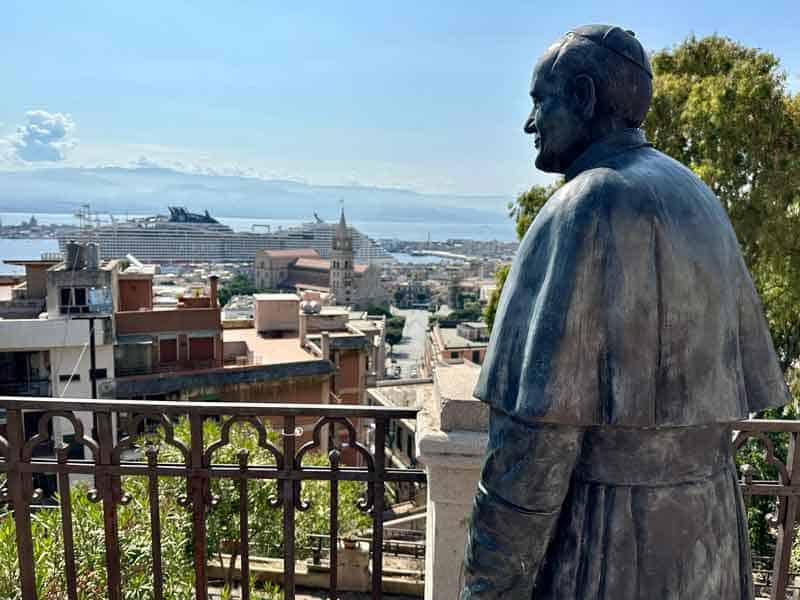
On the platform in front of the church, we also found a life size bronze statue of Pope John Paul II. Apparently, he admired the view from the Sanctuary of Montalto during his visit to Messina in the 1980s, so the city decided to immortalise the moment.
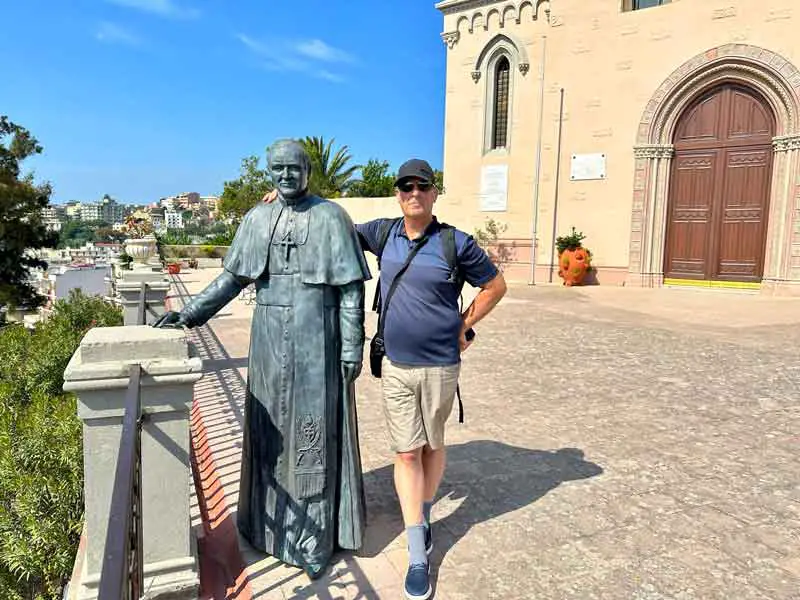
TIP: Although the Sanctuary of Montalto is often overlooked by tourists, visit early in the morning. Asides from a local enjoying the view, we were the only travellers at this time which made for a very peaceful and enjoyable visit.
5. Tempio Votivo di Cristo Re (The Shrine of Christ the King)
To reach the Tempio Votivo di Cristo Re from the Sanctuary of Montalto, we re-traced our steps to the Piazza Basicò and followed the road (Via delle Carceri) uphill for about 13-minutes. We then joined the Viale Principe Umberto on which the temple is located.
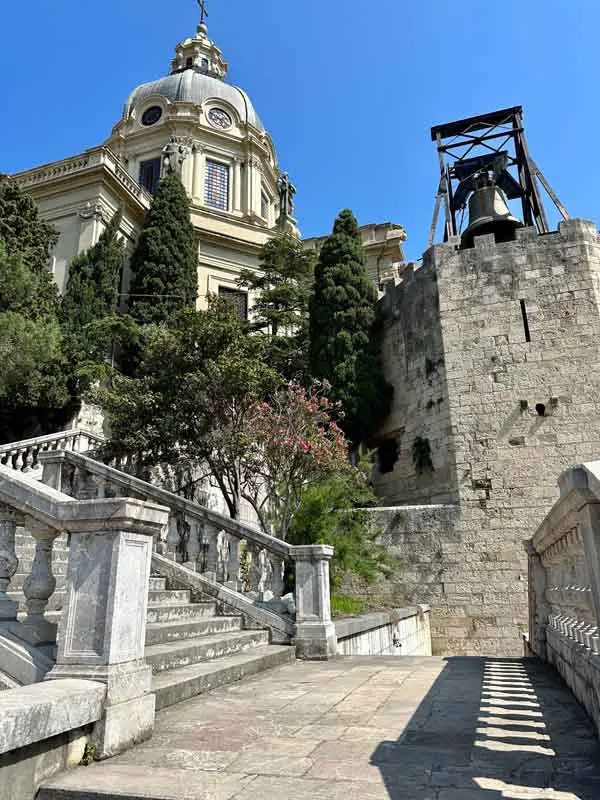
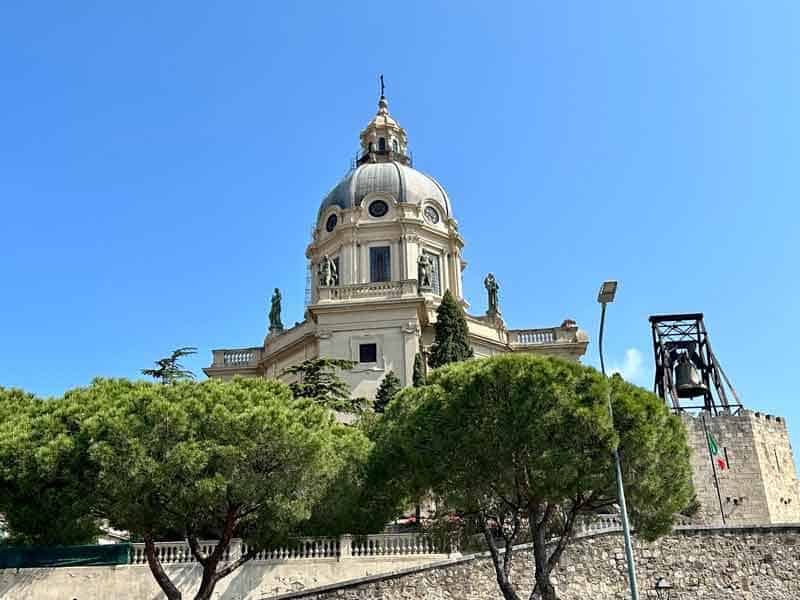
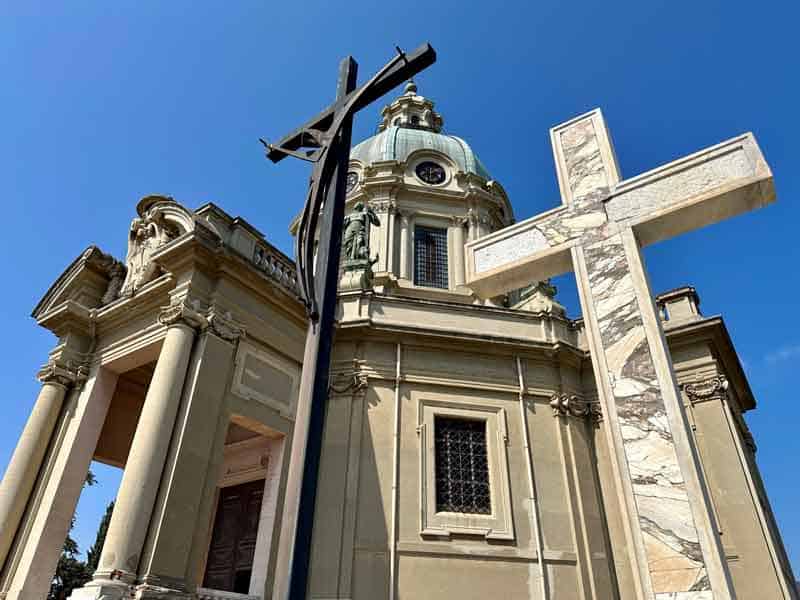
The Tempio Votivo di Cristo Re is a beautiful domed building that dominates the city below and it is one of the first things you spot from the sea. Its octagonal shape pays homage to its past as the Tempio Votivo di Cristo Re is built on the elevated site of the octagonal tower of the former Castle of Roccaguelfonia or Matagriffone.
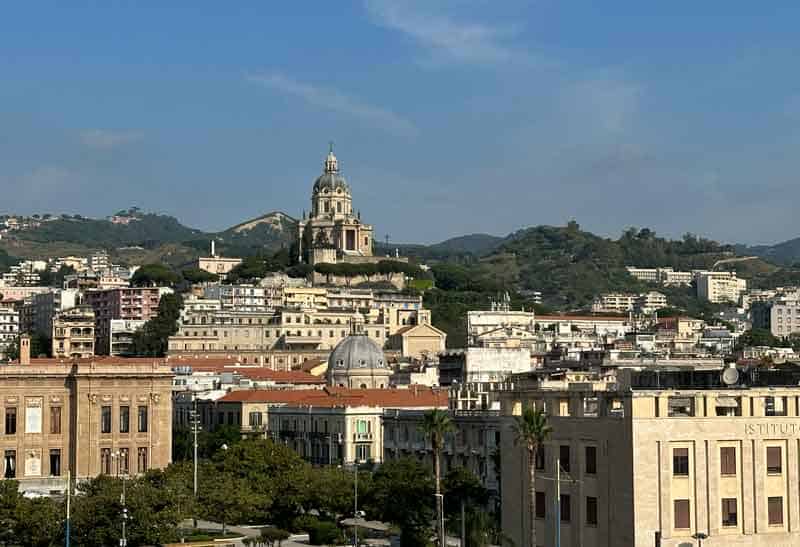
Today, the Tempio Votivo di Cristo Re is a church and war memorial. Although you must pay to enter the church, there is still a lot to enjoy from the outside for free.
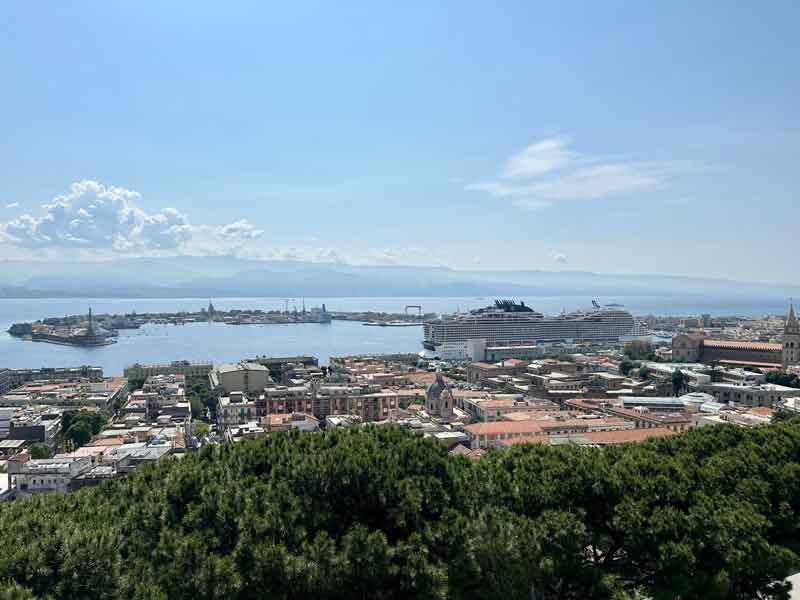
Firstly, there is a magnificent panoramic view of Messina and the harbour from the terrace below the Tempio Votivo di Cristo Re. However, if you climb up the steps of the beautiful marble staircase to the temple itself, you can get an even higher bird’s eye view from several platforms in front of the church.
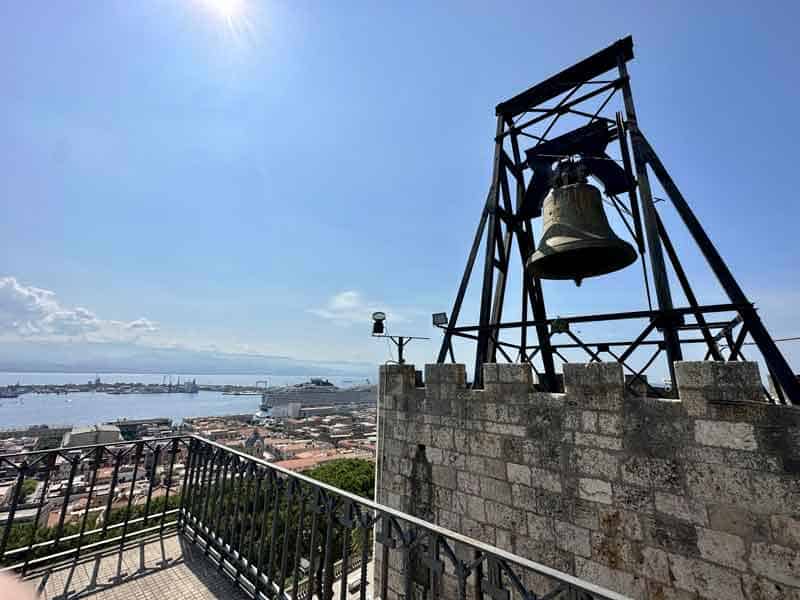
Up here, you can stand close to the temple and admire its octagonal structure and external architecture. We also discovered an enormous bell that was cast from the bronze of enemy canons seized during the First World War.
TIP: Plan to arrive early in the morning at the Tempio Votivo di Cristo Re for the best experience. This landmark is one of the most popular places to visit in Messina and gets very busy with tourists and tourist buses.
6. Parrocchia Santa Maria Di Pompei (Church of Saint Maria of Pompeii)
The Parrocchia Santa Maria Di Pompeii is a 10-minute walk from the Tempio Votivo di Cristo Re. This is another stunning church that enjoys a panoramic hilltop position.
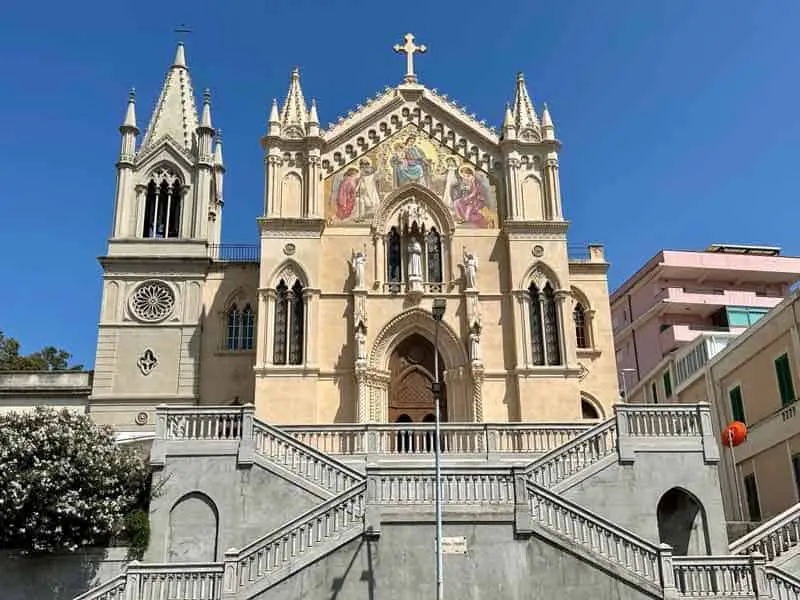
On the way, we found another church (see the photo below) with a great view of the Tempio Votivo di Cristo Re. By now, you are probably realising that Messina is full of beautiful churches!
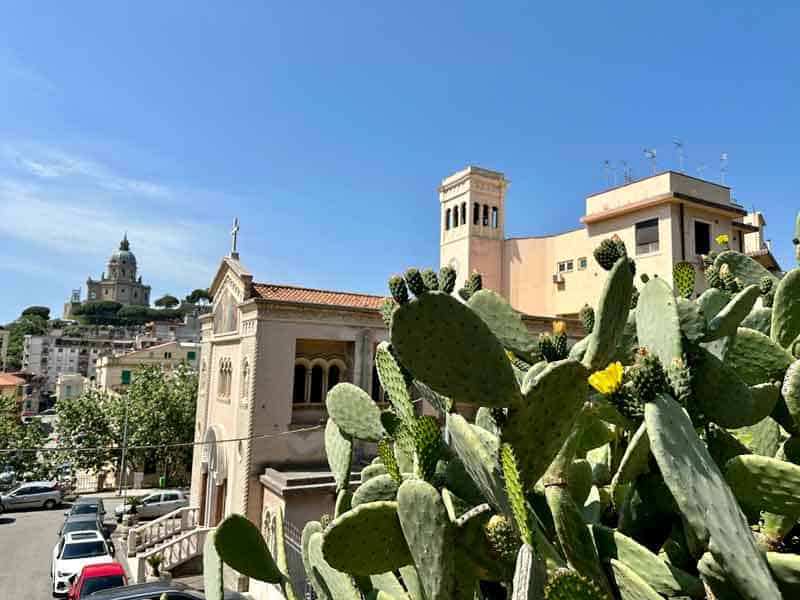
We discovered the Gothic style Parrocchia Santa Maria Di Pompeii church by chance as we wandered through the winding streets and cobbled cut-through passageways of Upper Messina that run parallel to the sea.
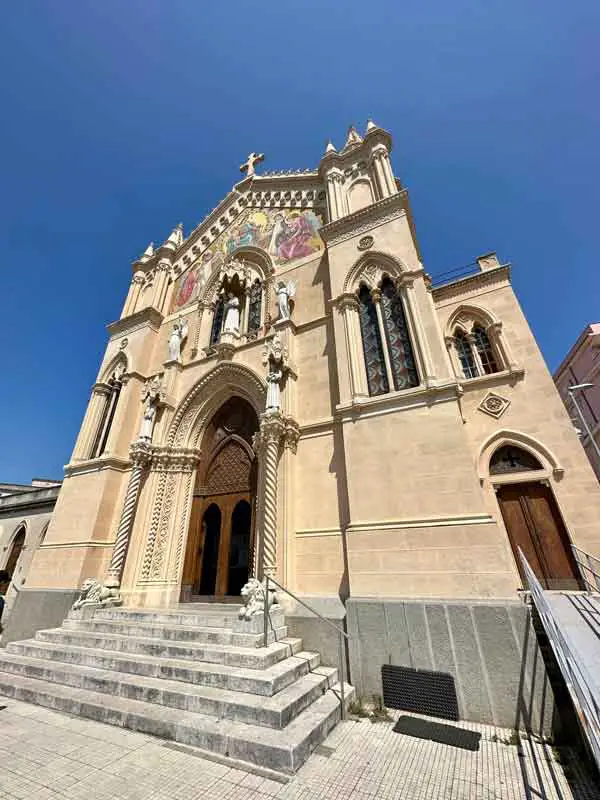
The church has an unusual and very grand double staircase plus a beautiful mosaic on the façade featuring the Archangels Michael and Gabriel. Two lions also keep guard at the base of the columns on each side of the church doors.
TIP: For a shortcut to the Church of Saint Maria of Pompeii, climb the stairs from the Piazza San Giovanni Decollato (off the Via San Giovanni Decollato). Look back and enjoy the view!
7. Fontana di Nettuno (Neptune’s Fountain)
From the Parrochia Santa Maria Di Pompeii, we meandered our way back down to the sea. After an 8-minute walk, we reached one of Messina’s symbolic monuments – the Fontana di Nettuno.
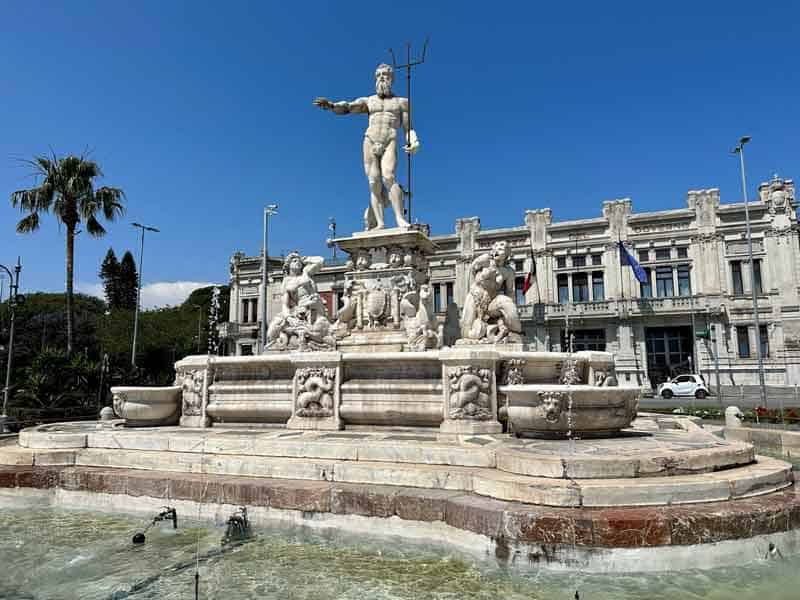
Neputune’s Fountain dates to 1557 and was created by the sculptor Giovanni Angelo Montorsoli. In its original position, Neptune had his back to the sea in line with a local legend. Today, the God of the Sea gazes over the water with the sea monsters, Scilla and Cariddi, chained at his feet.
TIP: Messina is a mythological city that was founded by a Greek in the 8th century BC. According to legend, the sea monsters Scilla and Cariddi lived in the Strait of Messina. Scilla guarded the Strait of Messina and Cariddi, the Sicilian coast.
8. Galleria Vittorio Emanuele III (Vittorio Emanuele III Gallery)
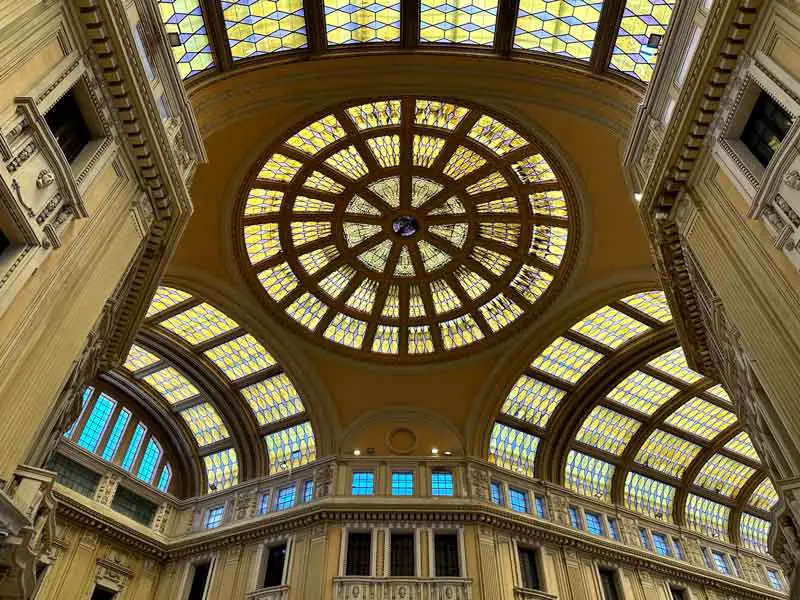
A 10-minute walk from Neptune’s Fountain on the Piazza Antonello is the Galleria Vittorio Emanuele III. We briefly visited this grandiose building with its striking architecture. However, it is also a surprisingly underutilised shopping mall.
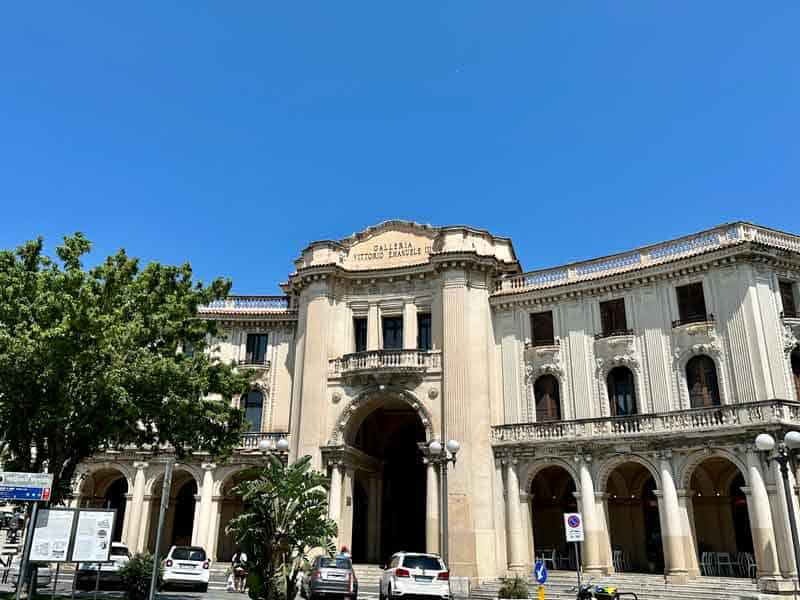
TIP: Look up to see the intricate decoration on the arches of the Galleria Vittorio Emanuele III and the diamond-patterned glass roof.
9. Basilica Cattedrale di Santa Maria Assunta (Messina Cathedral)
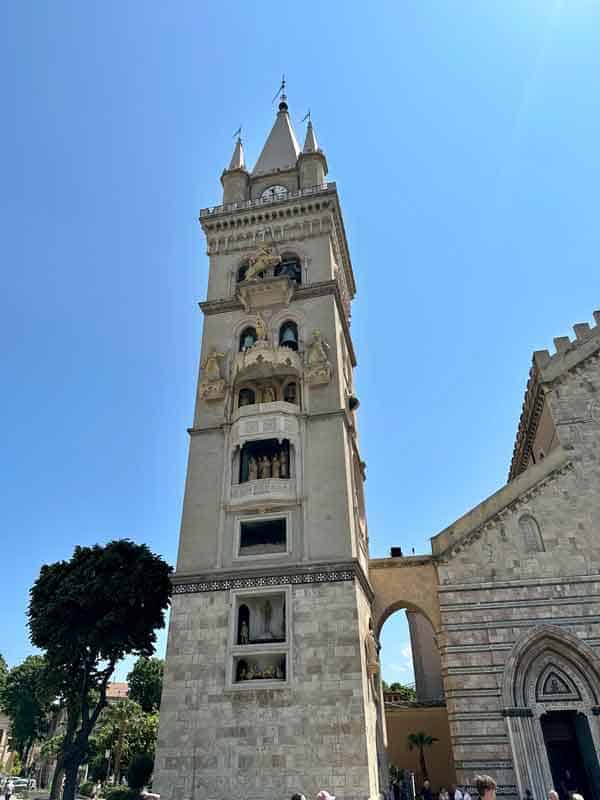
Close to the Galleria Vittorio Emanuele (approximately a 4-minute walk away) is the Piazza Duomo which is dominated by the beautiful Basilica Cattedrale di Santa Maria Assunta with its bell tower and astronomical clock.
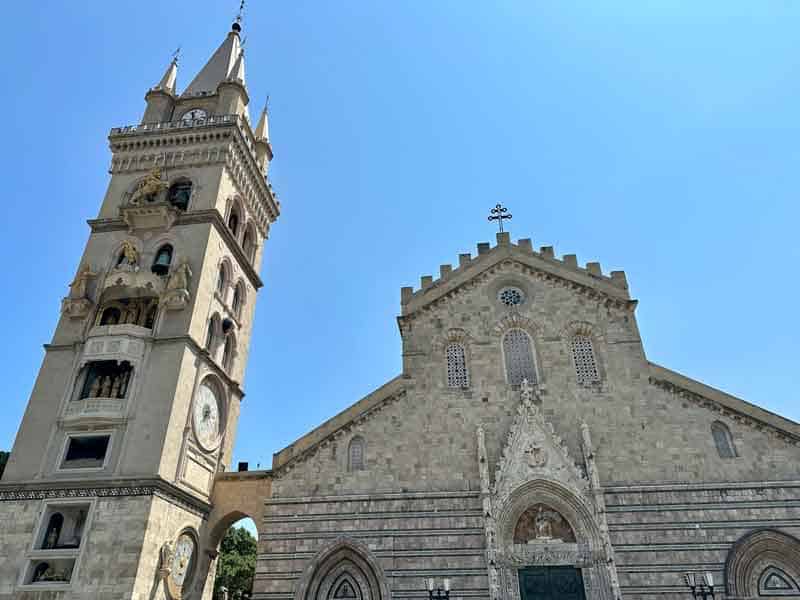
Messina Cathedral is one of the most well-known attractions in the city and is free to visit. Not only is the cathedral interesting to explore, but the bell tower also features the largest astronomical clock in the world! Every day at midday, crowds gather in the Piazza Duomo to witness the performance and we had to join them.
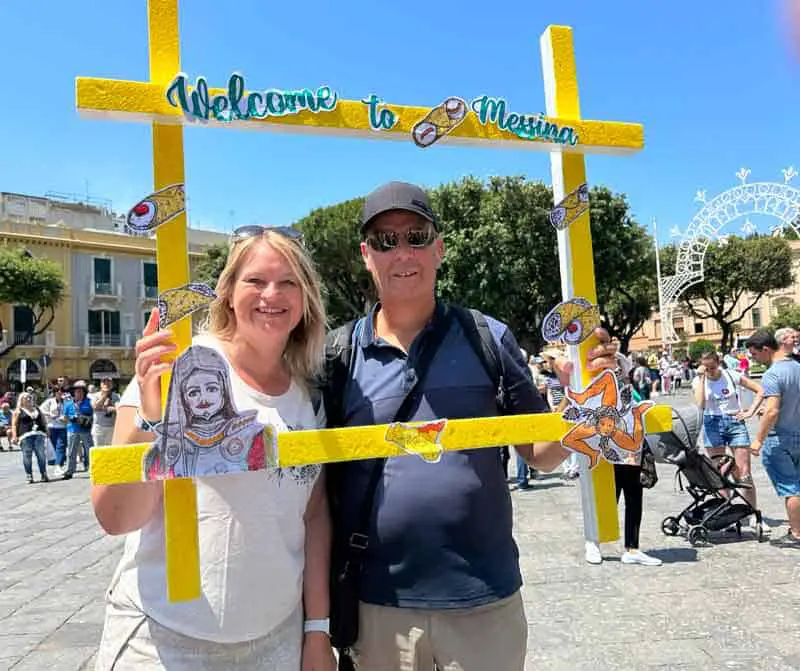
Whilst we were waiting for midday, we met a group of school children who were interviewing tourists to practise their English. As a former primary school teacher, it was lovely to help them, and they introduced us to a local food specialty called La Pignolata (delicious fried dough glazed in lemon and dark chocolate icing) and told us about local legends.
Once the clock struck 12, all eyes looked up and silence fell across the square as a lion started the performance with a ferocious roar. To the haunting sounds of the Ave Maria, we were transfixed on the 12-minute parade of bronze statues that slowly emerged from the arches overhead. This ancient form of storytelling had us all under its spell.
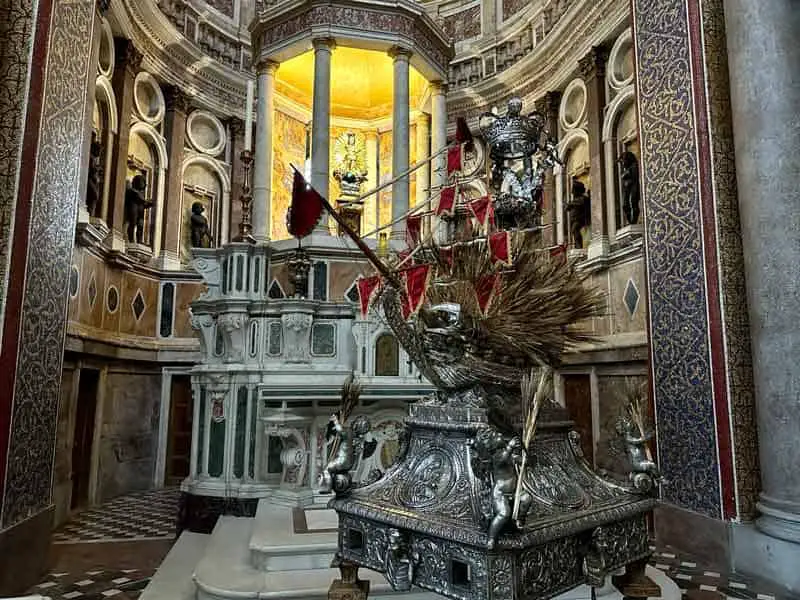
It is also worth going inside Messina Cathedral. Sadly, the cathedral has been destroyed and reconstructed several times over the centuries, but it has been beautifully rebuilt with magnificent architecture and intricate mosaics.
Outside the cathedral in the Piazza Duomo is also the Fontana d’Orione (Orion Fountain) but it was sadly off limits the day we visited as restoration work was underway.
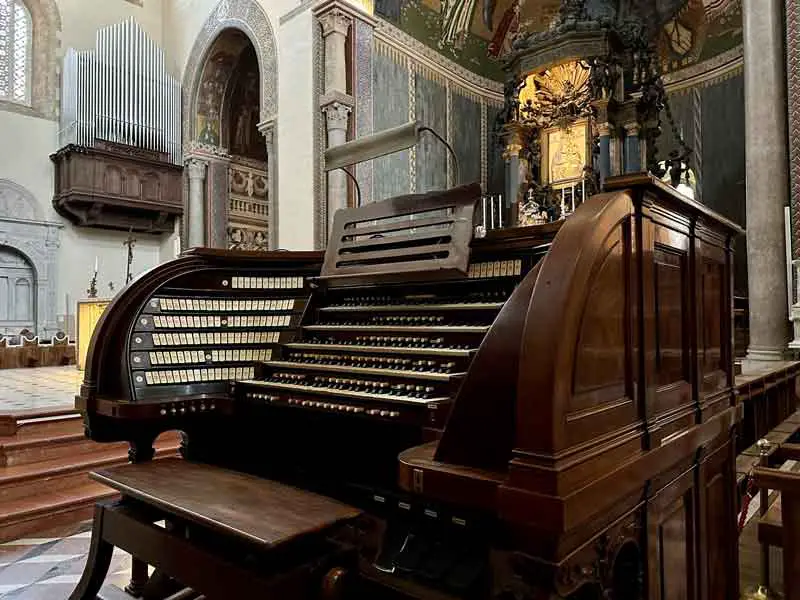
TIP: Inside Messina Cathedral, you will also find the largest organ in Italy!
10. Chiesa Santissima Annunziata dei Catalani (Church of the Santissima Annunziata dei Catalani)
A short 3-minute walk from the Piazza Duomo towards the cruise ship terminal is a very different kind of church with a unique style.
The Chiesa Santissima Annunziata dei Catalani is the oldest church in Messina dating to the 12th century. This church survived the earthquake that devastated most of Messina in 1908 and is one of the best-preserved historical treasures of the city.
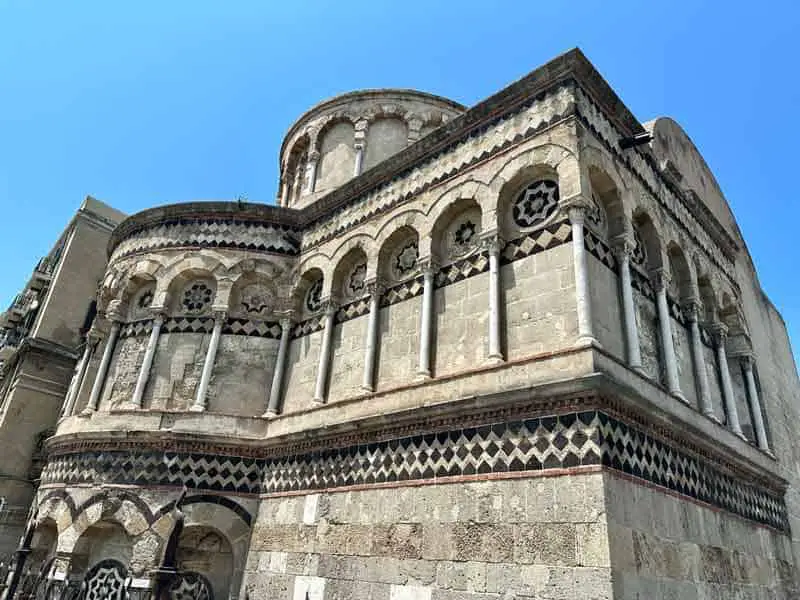
The Church of the Santissima Annunziata dei Catalani was built in Norman times between 1150 and 1200 on the ruins of an ancient pagan temple. It has a simple but striking architecture that merges Romanesque, Byzantine and Arab-Norman styles. Today, the church is the University of Messina’s chapel.
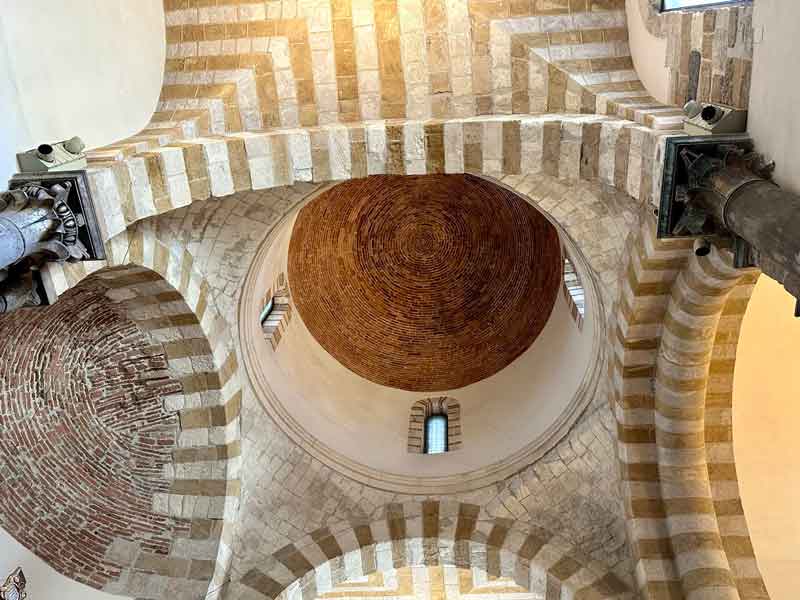
TIP: The Church of the Santissima Annunziata dei Catalani is not always open. However, it is definitely visiting the exterior as a complete contrast to the other religious buildings in Messina.
Final Thoughts on our One Day in Messina
Our one day in Messina was a truly memorable experience for its stunning churches and striking architecture. However, the city also has a modern, spacious feel with large squares, long streets, and lots of greenery.
If you visit Messina, be prepared to trek up steps and walk uphill! However, you will be rewarded with some stunning views of Messina all the way to the mainland of Italy. The other great thing about Messina was that we could see all of these beautiful things for free!